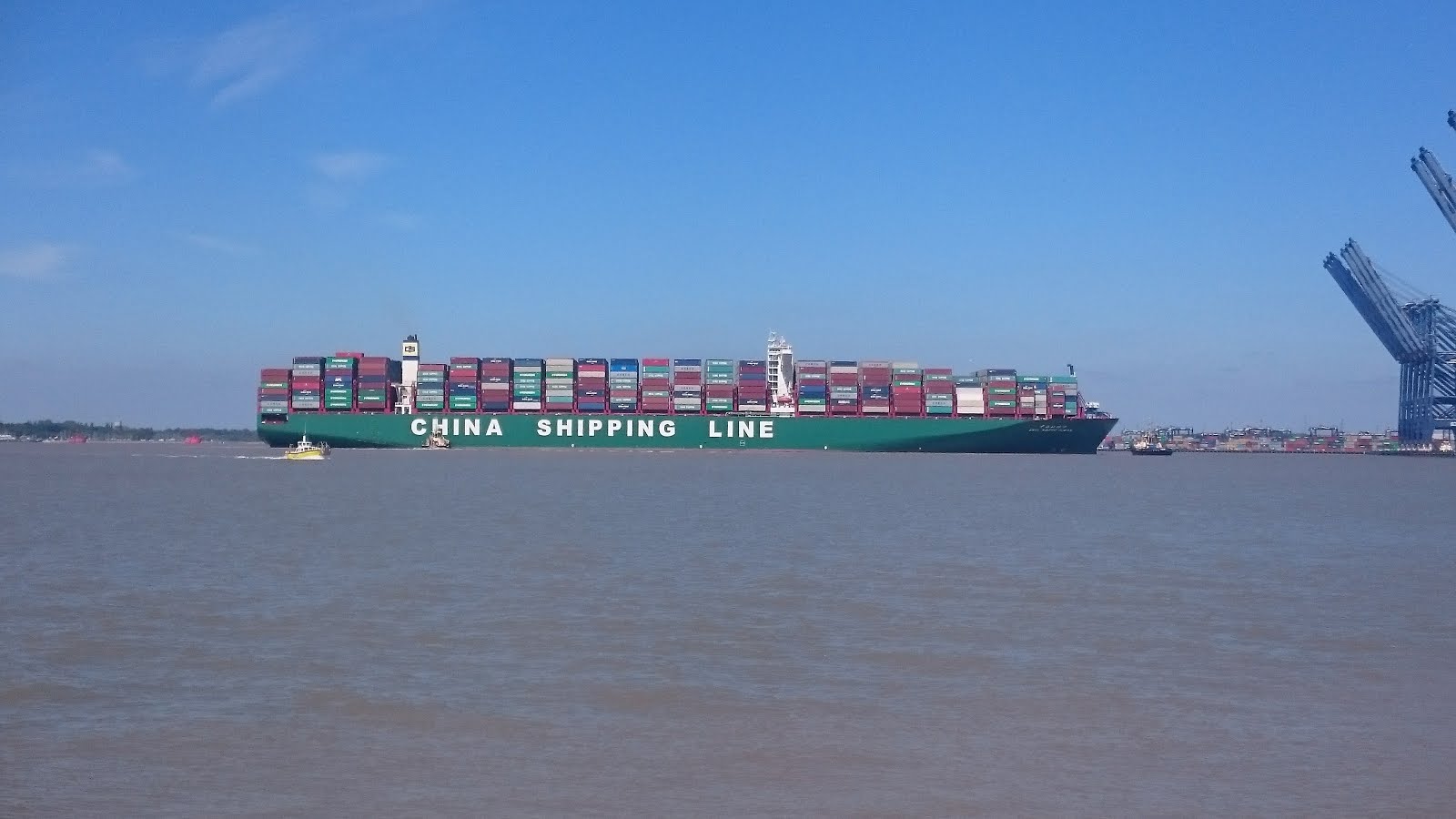
The Thalassa Doxa sails from Rotterdam with a maximum draught of 12.1 metres. The pilot climbed aboard at the Sunk Pilot Station close to international waters. Proceeding inwards via the deep water channel, the pilot orders two tugs for berthing. The first at the Platters to make fast centre lead aft and the second inside the harbour on a bow to bow.
A little while later the Svitzer Deben leaves the tug pontoon to be the aft tug followed by the Sky about 10 minutes later. Passing 7&8 Buoys, the Thalassa Doxa's bow comes in to sight as she appears from behind MSC Tina alongside on Berth number 9. Svitzer Deben makes fast centre lead aft as she approaches the Beach End turn into the harbour.
As the Thalassa Doxa begins to go on a Northerly heading up the harbour Svitzer Sky makes fast forward on a bow to bow. Further up the harbour the pilot goes astern on the main engine then gets Sky to move out on the port side to swing the bow around. A minute later the pilot gets the Deben to move out onto the starboard side to swing the stern around. Swinging to port fairly swiftly, the pilot uses the bow thrusters releasing a puff of smoke from the funnel.
Swung around the pilot backs the Thalassa Doxa up the harbour towards Trinity 7 where she was berthing. Passing Trinity 5 the Deben comes in to a push position on the starboard quarter. Once the Deben was in position ready to push, the pilot gets them to increase their power to push her towards the berth.
The 366 metre Maersk Essex departs Felixstowe Berth 7 with the assistance of two Svitzer tugs. With a draught of 14.5 metres for her next port of Le Havre. Last of the cranes booms up as the pilot boards the ship. The two tugs and the mooring gang head up to Berth 7. Svitzer Deben and Svitzer Sky leave the tug pontoon to head up the harbour. Deben makes fast starboard of centre aft and the Sky makes fast centre lead forward.
As the tugs back away, lines aft begin to slacken for the mooring gang to release them off the bollards. Last of the springs were released so the pilot could proceed with the departure. The pilt gets both tugs to lift off at half power before increasing them to full power. Kicking astern on the main engine the pilot uses the bow thrusters aswell to help the bow out away from the berth.
Clearing the berth, the pilot goes ahead on the main engine and gets the Sky to stop towing and get in a position to let go. After Sky is clear the Deben closes up to let go.
The HSL Sheffield departs a breezy Felixstowe. HSL Sheffield sails on the Colombia Express which is mostly reefers carrying bananas and other exotic fruits. Svitzer Sky made fast aft gently pulls the ship away from the berth. After a little bit the pilot comes ahead on the main engine while swinging the bow out. As the wind was gusty, the pilot holds on to the Sky around the 90 degree Beach End turn out of the harbour.
The deep draughted MSC New York prepares to depart the Port of Felixstowe bound for Tanjung Pelepas in Malaysia. As the last crane boomed up the pilot confirms the draught which was 14.8 metres and he required the two tugs and mooring gang.
The winds, a fresh North Westerly gusting upto 24 knots was going to make this departure a bit more difficult.
The Svitzer Kent and Svitzer Shotley leaves the tug pontoon to head for the MSC New York. The pilot goes through the plan of departure. As the New York is 399 metres, the pilot wanted the bigger tug Svitzer Kent aft as she has more bollard pull and able to perform a powered indirect out of the harbour.
Svitzer Kent makes fast on the centre lead aft while the Svitzer Shotley makes fast on the centre lead forward. Both tugs back away ready to pull the MSC New York off the berth. The lines fore and aft were slackened as they singled up. With the springs to go the pilot gives the tugs the heads up they are almost ready to depart.
Springs let go, the pilot gets the Kent to lift off at 50% while a few seconds later the Shotley is asked to build up to 50% aswell. The pilot then gets the Kent to increase to full power. New York edging away from the berth, the bow begins to swing out too soon so the pilot reduces the power of the Shotley. The pilot uses the power of the tide to bring the stern out. The pilot gives a kick astern on the main engine then a few longer bursts to help the ship move out into the channel. Slowly entering the channel the pilot increase the Shotley's power to swing the bow out.
Wind still buffering on the starboard side both tugs pull the vessel clear of the berth into the channel. Kent drops in astern while the Shotley comes in to let go. Shotley peels off onto the Felixstowe side and positions on the most aft tug marker just incase the pilot required more help turning the 90 degree corner out of the harbour. Kent readys themselves for a powered indirect. Approaching the Fort Buoy Kent gets the instruction to move out onto the starboard side at full line load to help steer the ship around the corner.
Once out of the harbour Shotley is no longer required and peels away from the MSC New York and heads back into the harbour. Kent eases up and closes up to retreive their tow line before breaking away from the stern to head back in to the harbour for the tug pontoon.
The Maersk Sentosa arrives to the Port of Felixstowe as a squall passes through the harbour. The Sentosa sails as part of the 2M alliance with MSC on the TA2 route which links the East Coast of America and Northern Europe.
A Harwich Haven pilot boards the Sentosa at the Sunk Pilot Station roughly 12 miles out in the North Sea. Unknown to the pilot at the time, a squall was heading for the harbour. Once onboard he gets the latest on the weather and traffic from Harwich VTS. Earlier in the morning there had been several departures from Felixstowe and Harwich. Firstly the ferries Stena Forerunner departed Harwich shortly followed by the Suecia Seaways. After the Ferries, deep draughted MSC Heidi left Felixstowe Berth 7. Stena Britiannica left Harwich and finally Seaspan Jakarta left Felixstowe Berth 6 taking up the rear of the ships outbound. The pilot orders two Svitzer tugs, the first one to meet at the Platters to make fast centre lead aft and the second inside the harbour on a bow to bow.
The Svitzer Kent left the tug pontoon to be the aft tug. Svitzer Shotley broke away from the pontoon about 5 minutes later to be the forward tug. As the Maersk Sentosa was heading inwards, the sky began to darken and VTS advised there was a squall about to pass through. Just as the Sentosa was rounding the Beach End turn into the harbour, the heavens opened and the rain fell heavier and heavier making visibility poor in the harbour.
Inside the harbour and on a northerly heading, the pilot asks for an update on the wind speed on the Landguard as the squall was battering the port. After VTS gives an update the pilot confirms that he would be doing a port swing then back up to the berth. Kent made fast aft is requested to lay back at 25% to help slow Sentosa then increase power soon after.
The skies begin to brighten and the rain eases as the squall moves away from the harbour. The Shotley is requested to move out onto the port bow and increase power to take the bow around while the Kent moves out onto the starboard quarter and maintain power as they take the stern around. Swung around the pilot gets both tugs to stop towing as the ship backs up towards the berth. Backing up the harbour, the pilot gets the Kent to move onto the starboard side with some weight on the line.
Approaching the berth with the Shotley on the starboard side waiting for the next instruction, Kent was asked to come in for a push towards the berth. Almost in position on Felixstowe Berth 6 the spring lines forward and aft are made fast on the bollards. The Kent and Shotley are released and head back down to the tug pontoon unill the next work a couple of hours time.